Don’t Bin Your Ambassador Program. Transform It.
Why your ambassador program won't deliver what you hope for, and what to do about it.
Source: Canva
I was an Ambassador once
I was once named an "Ambassador" for a corporate initiative. At first, I felt flattered. Finally, I thought, they're recognizing my value. I enjoyed the ego boost. And I was curious: what exactly was I going to be an ambassador for? A culture transformation? A better way of working together? New, modern practices?
I found out soon enough, at a day-and-a-half seminar with twenty or so fellow ambassadors in a hotel on the outskirts of Frankfurt. What a letdown.
For a day and a half, joyless consultants force-fed us corporate content and business updates, like geese being fattened for foie gras. All of it served one person: the executive committee member funding the session, who headed a new business line with big growth ambitions. The content was more or less disconnected from our working lives (in my case, completely). Nobody showed any interest in who we were. No effort to connect us, or to build any kind of human relationship. The sponsor and the consultants seemed to share a single goal: to train us to regurgitate information to our colleagues. Ideally, to turn us into loudspeakers for the gospel.
A purely transactional relationship.
In the service of one individual's career ambitions.
Top-down, dressed up as a "network effect".
And no intention whatsoever of changing how the company worked, even though it badly needed it.
Me, an "Ambassador"? What a joke.
After that seminar, I never heard from the sponsor, or my fellow "ambassadors", again.
As for the swag we were handed, which bore the name of a project I have long since forgotten, I never wore it again.
The pattern I keep seeing
Your ambassador program is probably better built than that one. I hope so! But I've seen this from both sides: 17 years inside Sanofi, where I helped build several grassroots networks gathering thousands of people across the world, then eight years as a consultant. And I recognize the same underlying traits in a great many of the programs I come across.
On paper, the idea is sound. Champions, ambassadors and multipliers can give a transformation a human face. They bring local knowledge, credibility, relationships and reach that no central transformation team can replicate.
In practice, their role tends to shrink to cascading messages, promoting initiatives and gathering feedback. Members may be highly committed. Yet they have few opportunities, methods or the confidence to bring people together around difficult issues, work across boundaries, and help colleagues turn the transformation into action.
The result is a program that:
• changes nothing in the organization's relational dynamics, or in its deep-rooted ways of working;
• adds nothing in terms of personal agency, agility or collective mobilization;
• can even undermine the credibility of the people who play along.
None of this comes from bad intentions. Sponsors want reach and speed, and the ambassador model is the familiar way to get them. But without daring to admit it, and sometimes without even realizing it (you don't know what you don't know), the sponsors of these programs end up with measurable impact far below what they hoped for.
And yet, it doesn't have to be this way.
From messengers to enablers
Large transformations may have a clear strategy, governance and program structure. But in the end, change happens through thousands of conversations, decisions and actions across the organization. So the real question isn't how to get people to understand the transformation. It's how to help them make it happen.
There is a way to make this kind of program far more valuable, for the organization and for the people who take part. I call it people-powered transformation. I've been practicing it for more than 12 years, in sectors as different as biotech, aviation and industry. Right now, with my partners at Emerging World, I'm applying it at a global industrial company of around 6,000 people.
Here is how it differs from a classic ambassador program.
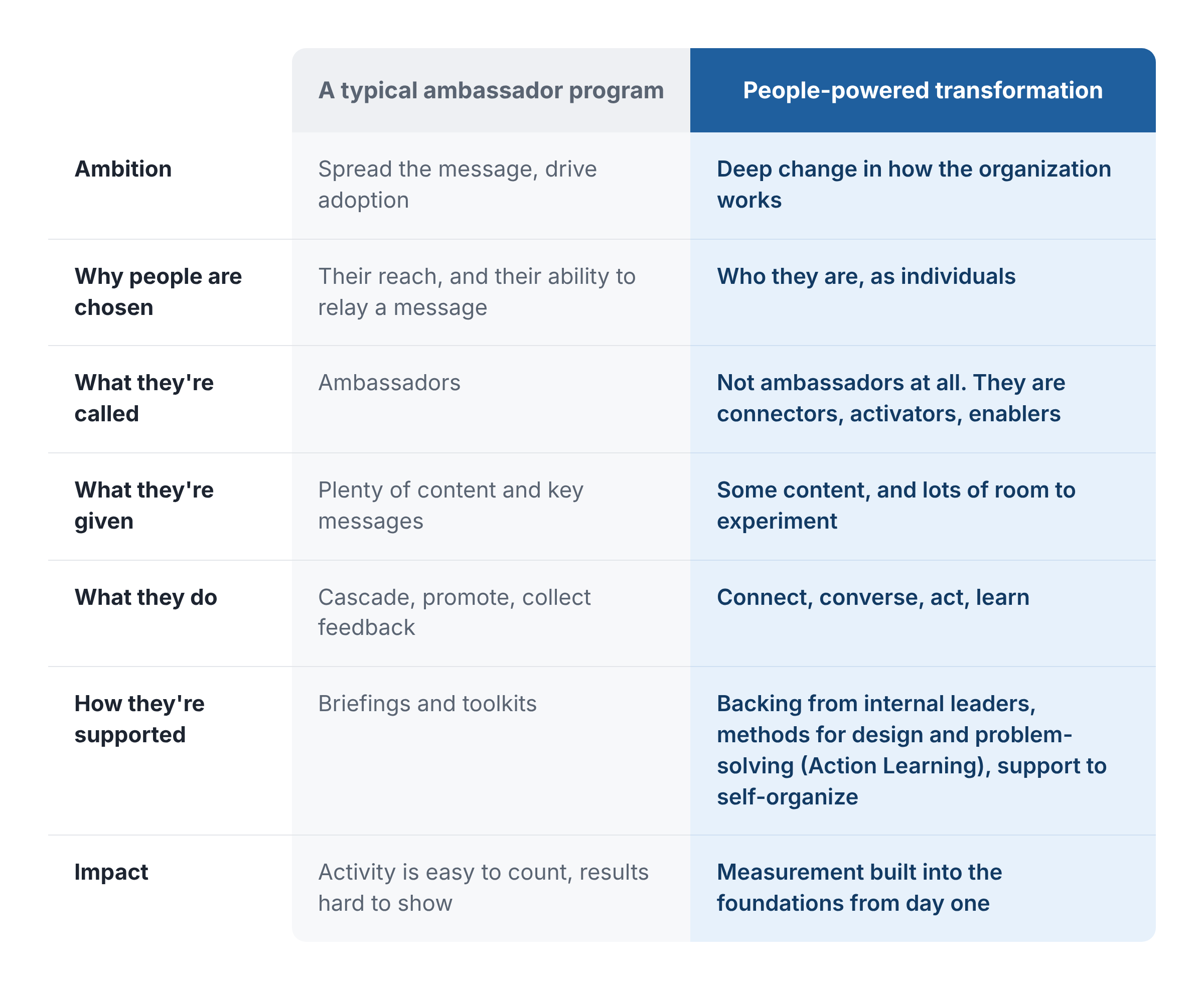
The name matters. We avoid "ambassador" precisely to make clear that these people aren't transmission channels. Their job is to help many more colleagues change, whether that means adopting AI or a new way of working together. And because they are encouraged to experiment, they grow their initiative and their skills along the way. If there's one word worth keeping, it's "multiplier", taken literally: their role is to multiply other people's capacity to act. That is the heart of the relational leadership I describe in Dare to Un-Lead.
What this produces that an ambassador program can't
• Deep, lasting change in the organization and its ways of working: stronger networks, more trust, more autonomy, and real, measurable business results.
• A new perspective for the people involved, on their organization and on themselves. For many, it becomes a highlight of their career.
• Skills developed at scale, well beyond the core group.
• Smoother adoption of new processes and technologies.
• Motivation multiplied, because people are acting on what matters to them, not repeating someone else's script.
This isn't theory. At Lufthansa Cargo, I coached a coalition of around 35 volunteers from 18 countries who led the adoption of a new algorithm-based pricing and booking system across the entire sales force (= AI, before it was known as AI!). The rollout took six months instead of two years. When Covid hit, online booking was already up and running worldwide, just as clients and employees found themselves stuck at home. To this day, the former volunteers describe the experience as life-changing: the highlight of their careers.
Your ambassador program can be the starting point
Here's the twist. The industrial program I mentioned started as an ambassador program.
In late 2025, the company issued a brief for an "Ambassador Initiative": take the transformation's content and messages to every country and site, and recruit more ambassadors over time. To its credit, the brief already reached further. It wanted these people to be employees' voice in the transformation, and to offer a safe space for that voice.
We took that ambition seriously and built on it. The volunteers aren't called ambassadors. They come from across functions, sites and countries, on the shop floor and in the office. Together they have run festivals at their plants, collected and shared "wins", and taken on real transformation challenges, with internal Action Learning coaches being developed to support them. A second cohort of volunteers is about to join.
So the question isn't whether to have an ambassador program. It's what you equip it to become. If you already have champions, ambassadors or multipliers, try asking:
• Purpose: Are they mainly communicating the transformation, or helping people make it happen?
• Capability: What are they actually equipped to do?
• Agency: How much freedom do they have to respond to what they encounter locally?
• Connection: Are they a collection of individuals, or a community that learns and acts together?
• Learning: How does what they discover feed back into the wider transformation?
We don't call what we do an ambassador program, even if one can be where it starts. We call it people-powered transformation. It goes a great deal further.
If you work in-house on transformation, with ambassadors, champions, multipliers or none of the above, come and compare notes. Matthew Farmer of Emerging World and I host regular online meet-ups on people-powered transformation: 60 to 90 minutes, free and cross-sector. No consultants (apart from the two of us), just experienced professionals sharing what they do and see in the field. Peer learning at its best.
Get in touch if you'd like to join us.